Why Did My Website Impressions Drop in September 2025? Understanding the Google Search Console Reporting Change
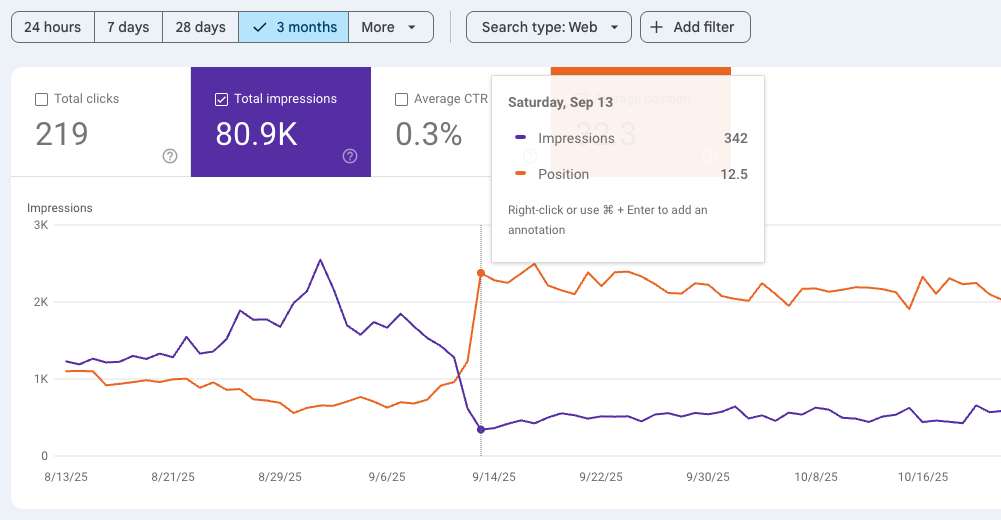
While impressions dropped, overall search position actually increased!
If your Google Search Console impressions dropped in September 2025, don't panic. You're not alone, and you probably didn't lose any actual traffic.
As someone who monitors Search Console data for dozens of clients across different industries, September 2025 stood out. Throughout the month, I noticed a consistent pattern emerging across our client portfolio: impression counts were trending downward significantly. Plumbing companies in San Diego, law firms in Los Angeles, local brick-and-mortar shops, dog trainers—it didn't matter the industry or location. The trend was universal.
Now, SEO metrics are a lot like the stock market—they fluctuate daily. A single day's drop isn't cause for concern; we're always looking for trends and directional patterns over weeks and months. But this wasn't normal volatility. Across completely different industries and website types, impressions were consistently dropping 40-60% throughout September, while something unusual was happening: clicks remained stable or even improved. Even more curious, average search positions were sharply improving at almost the same rate impressions were declining.
As an SEO professional, my first question wasn't "what did we do wrong?"—it was "what's actually happening here?" When impressions drop but clicks hold steady or improve, and average positions get better, that's not a ranking problem. That's a data reporting anomaly. Organic traffic in Google Analytics confirmed it: traffic patterns were stable or growing.
Industry-wide analysis confirmed what I was seeing: sites experienced impression drops ranging from 40-60% on average, with some seeing even steeper declines, while actual traffic and click data remained consistent.
What we were witnessing wasn't a ranking catastrophe—it was a fundamental shift in how Google reports search visibility data.
What Actually Changed: The &num=100 Parameter Removal
To understand this September 2025 reporting change, we need to look at a technical detail that most website owners never knew existed: the &num=100 URL parameter.
For years, Google's search results included a query parameter that allowed users and, more significantly, automated tools to request up to 100 results per search query page instead of the standard 10. This parameter was heavily used by:
Third-party SEO rank tracking tools (Semrush, Ahrefs, etc.)
Automated crawlers and scrapers
API-based monitoring systems
Various bot traffic sources
These automated systems were generating "impressions" in Search Console—not because real humans were seeing your website listings, but because bots were pulling deep search results for tracking purposes.
Around September 11-12, 2025, Google quietly deprecated support for this parameter. The result? All those bot-generated impressions suddenly disappeared from Search Console reporting.
What Google Says About the Drop in Impressions
For weeks after the September drop, the SEO community was in a frenzy, flooding forums and social media with theories. Google remained characteristically quiet—until John Mueller decided to weigh in.
If you're not familiar with Mueller, he's one of Google's most visible Search Relations team members and a regular voice in the SEO community. He's known for his willingness to engage with webmasters (and his occasional dry humor). So when the panic about impression drops reached a fever pitch, Mueller posted on Bluesky:
"Maybe the real impressions were the friends we made along the way."
It's the kind of response that makes you simultaneously laugh and groan. But beneath the meme-worthy humor was a genuine point: those weren't real impressions in any meaningful sense. They were artifacts of automated systems, not human search behavior.
Shortly after Mueller's cryptic comment, Google provided a more direct (if less entertaining) explanation. A Google spokesperson officially stated to Search Engine Roundtable: "The use of this URL parameter is not something that we formally support."
Translation: The inflated impression counts from automated queries using the &num=100 parameter were never supposed to be part of Search Console reporting in the first place. Google wasn't taking anything away—they were correcting data that had been skewed by bot activity all along.
What the Data Actually Shows
When I analyzed the changes across our client portfolio, several patterns emerged that should reassure anyone concerned about this drop:
Clicks Remained Stable
This is the most important metric. Actual user engagement—the number of people clicking through to websites—didn't change. If impressions dropped but clicks stayed the same, what really happened? The denominator changed, not the numerator.
Average Position Improved
Many sites saw their average position metrics improve. Why? Because Search Console was no longer counting impressions for rankings in positions 50-100 where virtually no real users ever scroll. With those low-value impressions removed, the average position calculation became more accurate.
Desktop Data Was Most Affected
The impression drops were most pronounced in desktop reporting. This makes sense—most automated rank tracking tools run desktop-based queries rather than mobile searches. Mobile impression data, which represents actual human search behavior more accurately, remained relatively stable.
Industry Didn't Matter
Whether I was looking at a client in professional services, home services, retail, or specialized niches like dog training, the pattern was consistent. This wasn't a targeted change affecting specific industries—it was a universal reporting recalibration.
Why This Is Actually Good News
After the initial shock wore off, I realized this change is genuinely positive for SEO professionals and business owners alike. Here's why:
More Accurate Visibility Metrics
Your Search Console data now reflects actual human search behavior rather than a mix of real users and automated bot traffic. This gives you a clearer picture of your true organic visibility.
Better CTR Calculations
With inflated impressions removed, your click-through rate calculations are now more accurate. You can make better decisions about meta descriptions and title tags based on real user response rates.
Cleaner Year-Over-Year Comparisons
While you can't directly compare pre-September 2025 data to post-September data, going forward you'll have consistently accurate reporting. September 13, 2025, essentially became the new baseline for GSC reporting.
Focus on What Matters
This change forces SEO professionals to focus on positions 1-20, which is where real users actually engage with search results. Rankings beyond page two have always been largely meaningless for actual traffic—now the data reflects that reality.
How to Interpret Your GSC Data Now
If you're analyzing your Search Console performance after this change, here's what I recommend:
Don't Panic Over the Drop
If your impressions fell sharply around September 11-13 but your clicks and organic traffic remained stable, you didn't lose visibility. Your reporting just got more accurate.
Treat September 13+ as Your New Baseline
Any historical comparisons should acknowledge this as a data inflection point. Annotate your reports and dashboards accordingly. Don't try to compare August 2025 impressions to October 2025 impressions directly—they're measuring different things.
Verify With Google Analytics
Always cross-reference Search Console data with your actual organic traffic in Google Analytics. If GSC shows dropping impressions but GA shows stable or growing organic traffic, trust the traffic numbers.
Focus on Clicks, Not Impressions
While impressions have always been a useful vanity metric for visibility, clicks and conversions are what drive business results. This change is a reminder to prioritize actionable metrics over volume metrics.
Monitor Positions 1-20
Your rankings within the first two pages of search results are what matters. Use Search Console's position filtering to focus your analysis on keywords where you actually have a chance at capturing clicks.
The Impact on Third-Party SEO Tools
It's worth noting that this change didn't just affect Google Search Console—it also impacted third-party rank tracking platforms. Many SEO tools relied on the &num=100 parameter to track rankings beyond page two.
After September 2025, tools like Semrush and Ahrefs began showing incomplete data or missing keyword rankings for positions beyond 20. This isn't a failure of these tools—they simply lost access to the data source they were using.
This makes Search Console even more valuable as the authoritative source for your ranking data, since it's pulling directly from Google's systems rather than trying to scrape search results.
What This Means for SEO Strategy Going Forward
From a strategic perspective, this change doesn't require any adjustments to how you do SEO—but it does reinforce some fundamental best practices:
Prioritize Page One Rankings: If you weren't already focused on breaking into positions 1-10, this change makes that priority even clearer. Page two might as well be page twenty for actual traffic purposes.
Trust the Process: SEO has always been about genuine improvements to content quality, user experience, and technical performance. This reporting change removes some of the noise that made it harder to see the signal from your optimization efforts.
Educate Stakeholders: If you report SEO metrics to clients or leadership, take time to explain this change. The last thing you want is decision-makers panicking over a reporting adjustment rather than focusing on actual performance.
Measure What Matters: Impressions were always a top-of-funnel awareness metric. Clicks, conversions, and revenue are what drive business results. Use this as an opportunity to shift conversations toward outcome-based metrics.
A More Honest Picture of Search Visibility
Looking back at those September trends and the patterns that emerged across our client portfolio, I'm actually glad this change happened. It forced a necessary conversation about data quality and meaningful metrics in SEO.
The inflated impression counts from automated crawlers were creating a false sense of visibility. They made it harder to accurately measure the impact of optimization efforts and muddied the relationship between search presence and actual traffic.
Now, when I look at Search Console data for our clients—whether it's a plumber in Encinitas, a CPA firm in Orange County, or a dog trainer in Carlsbad—I can trust that the impressions represent genuine search visibility among real potential customers.
If you noticed this drop in your own Search Console data and were concerned about your SEO performance, hopefully this explanation provides some reassurance. Your rankings likely didn't tank. Google didn't penalize you. Your SEO efforts aren't failing.
Your data just got more honest.
Frequently Asked Questions
Why did my Google Search Console impressions drop in September 2025?
Google deprecated the &num=100 parameter around September 11-12, 2025, which removed bot-generated impressions from third-party tracking tools and automated crawlers. This made Google Search Console data more accurate by showing only real user impressions instead of a mix of human searches and automated bot queries. The change affected nearly all websites universally, regardless of industry.
Should I be worried about the September 2025 impression drop?
No. If your clicks and organic traffic remained stable (check Google Analytics to verify), your actual visibility didn't change. The drop represents more accurate reporting, not lost rankings. In fact, many sites saw their average position improve during the same period, which confirms this was a data correction rather than a performance issue. Your website is likely performing just as well—or better—than before.
Did Google penalize my website in September 2025?
No. This was not a penalty or algorithm update. Google simply stopped supporting a URL parameter (&num=100) that automated tools were using to pull deep search results. The impressions you lost were never from real users who could click through to your site. Your actual search rankings and visibility to human users remained unchanged.
How should I report SEO metrics after this change?
Treat September 13, 2025, as your new baseline for Search Console reporting. Don't try to compare pre-September and post-September data directly—annotate your reports to explain the data inflection point. Focus on metrics that matter most: clicks, conversions, and actual organic traffic from Google Analytics. If you need help interpreting your post-update data or developing an accurate SEO reporting strategy, consider working with a data-driven digital marketing agency that understands these technical changes.
Will third-party SEO tools like Semrush and Ahrefs work differently now?
Yes. Many rank tracking tools relied on the &num=100 parameter to monitor keyword positions beyond page two. After September 2025, these tools may show incomplete data or missing rankings for positions 21-100. This doesn't mean your rankings disappeared—it means the tools can no longer access that data. Google Search Console is now more valuable than ever as your authoritative source for ranking data, since it pulls directly from Google's systems.
Sources and Further Reading
Primary Sources:
Schwartz, Barry. "Google Somewhat Comments On Search Console Impressions Dip With 100 Results Change." Search Engine Roundtable, September 18, 2025. (Google's official statement on the &num=100 parameter)
Schwartz, Danny. "Why Google Search Console impressions fell (and why that's good)." Search Engine Land, October 2025. (Comprehensive industry analysis)
Corsto Web Design. "Sudden Drop in Google Search Console Impressions After September 10 – What's Going On?" October 8, 2025. (Third-party tool impact analysis)
Evan Larkin is the founder of North County Digital, a full-service digital marketing agency based in Encinitas, California, specializing in SEO, local search optimization, and data-driven digital strategy for businesses across San Diego and beyond.