Google Ads is Killing Credit Card Payments: Local Businesses Are Paying the Price
How Google's quiet billing change is draining money from the small businesses that fund its $264 billion empire
This post was written after we spent weeks arguing with Google on behalf of a client spending $75,000 per month on Google Ads. When Google's billing change canceled their credit card payments and threatened account suspension, we had to navigate the fallout firsthand. If you're dealing with the same thing, here's what you need to know…

The Google Ads Billing Change: What Actually Happened
Google Ads has quietly stopped accepting credit and debit card payments for a growing segment of advertisers, forcing them to switch to either monthly invoicing or direct debit from a bank account. If you received an email threatening account suspension, you're not alone, and you're right to be angry.
Google's own notification to affected advertisers stated bluntly: "Your accounts have specific payment options and will only be allowed to use bank-based payment methods, which does not include credit or debit cards. There are no exceptions to this requirement for impacted advertisers."
No exceptions. No negotiation. Pay our way or we turn off your ads, as reported by Search Engine Land.
The Real Reason Google Is Doing This
Google's official line is that this move gives advertisers "flexibility" and "control." Don't believe it.
Credit card transactions typically incur fees ranging from 2-3%. While this might seem negligible, the impact on a company with Google's scale is considerable. By transitioning to ACH or wire payments, Google aims to save substantial amounts in fees, which can translate to hundreds of millions, possibly billions, of dollars in annual savings.
Let's put that in perspective. Google's advertising revenue reached $264 billion in 2024, representing 14.9% annual growth. Even shaving 2% off a fraction of that is worth staggering sums to Alphabet's bottom line.
If Google pays roughly 2% in credit card fees, a client spending $75,000 per month could cost the search engine $18,000 per year in fees alone. Plenty of companies spend much more than that.
This isn't about your convenience. It's about Google's profit margins.
What Small & Mid-Sized Businesses Are Losing
For local businesses, paying for Google Ads via credit card wasn't just convenient. It was a smart financial strategy. Here's what's being stripped away:
1. The Float (Your Interest-Free Buffer)
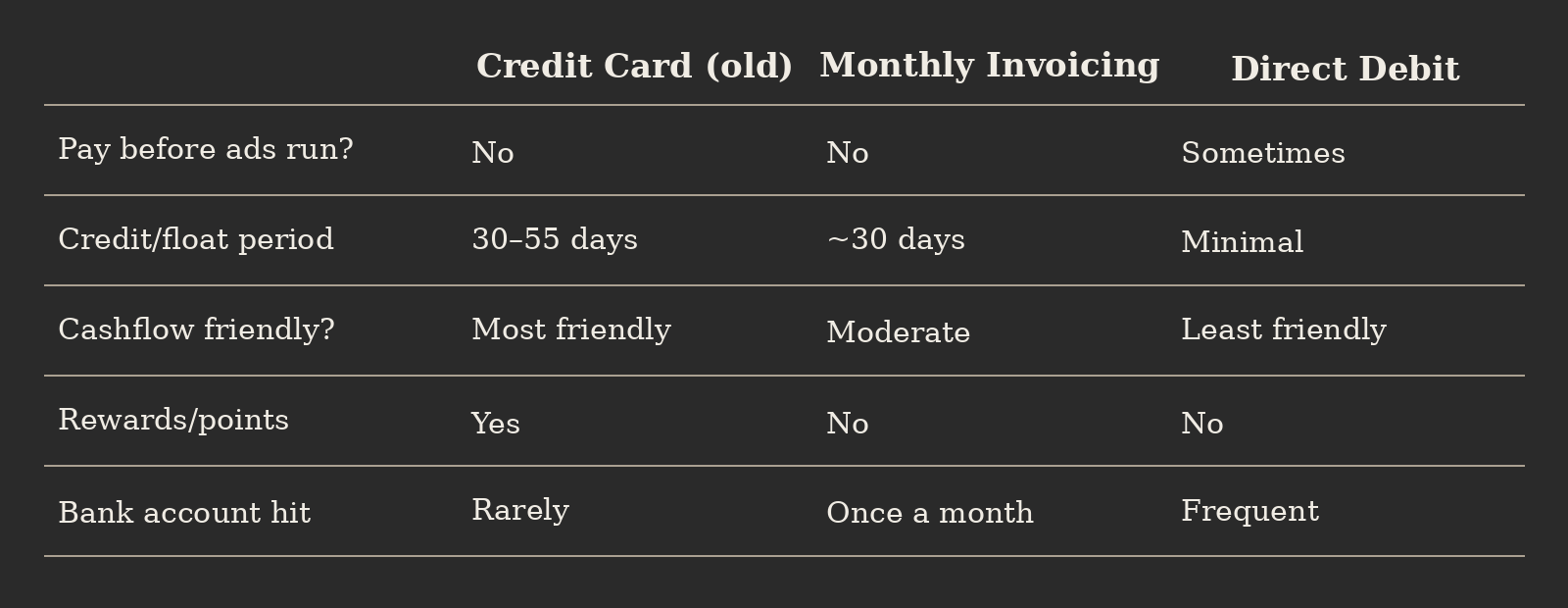
Credit cards give businesses 30-55 days between spending and paying. That's working capital. That's payroll breathing room. That's the ability to run ads in lean months and pay when revenue comes in. With direct debit, Google can pull from your bank account frequently, sometimes every few days.
2. Rewards Points Worth Real Money
This change directly impacts businesses that earn rewards on advertising purchases through major issuers like Chase or American Express. Popular cards like the Ink Business Preferred from Chase offer 3x Ultimate Rewards points on advertising purchases with search engines, which can add up to a considerable haul of points if your business spends hundreds or thousands of dollars on Google Ads every year.
For a business spending $30,000/month on ads, that's potentially $9,000-$18,000 per year in rewards, gone. Rewards that many local businesses count on to buy holiday gifts for staff, stock up on office supplies, or put cash back directly toward their advertising spend.
One high-spending advertiser put it plainly on social media:
"This change will cost us $250k+ per year. It does not benefit the customer in any way."Jeremy Brandt, Founder, We Buy Houses
3. Cash Flow Predictability
For high-spending advertisers, this change means needing to maintain larger cash balances in bank accounts to accommodate direct debits or wire transfers, which is particularly burdensome for businesses that rely on the float provided by credit card payment cycles.
For a local plumber, dentist, or real estate agent who depends on Google Ads for leads, being forced to keep more idle cash in a bank account is a real operational burden.
Here's how the three payment options actually stack up:
"It Only Affects Big Spenders" That's a Lie
Google initially framed this as targeting "high-growth" advertisers. The industry quickly pushed back.
Despite Google suggesting only large spenders would be affected, Reddit users reported that accounts spending less than $1,000 per month were also being forced to make the switch. This isn't a niche problem for enterprise advertisers. It's hitting Main Street businesses.
While Google claims the change offers flexibility and control, critics argue it causes cashflow issues and has led to far more negative blowback than Google anticipated.
Google's Monopoly Makes This Worse
This wouldn't sting as much if businesses had real alternatives. But they largely don't.
Over 7 million businesses and marketing agencies rely on Google Ads as their primary channel to reach customers through search, and Google holds a 39.37% share of the global PPC market. When you're a local business trying to show up when someone searches "plumber near me" or "best dentist in [city]," Google isn't optional. It's the only game in town.
Nearly half of all searches on Google are local, meaning people are looking for businesses, services, or products near them. That makes Google Ads especially critical for small local businesses, and it gives Google enormous leverage to impose terms like this one with little pushback.
The Courts Agree: Google Is a Monopoly
This isn't just an opinion. In April 2025, a federal judge ruled that Google illegally monopolized the ad tech market, finding that the company "willfully acquired and maintained monopoly power" over publisher ad servers and ad exchanges. It was the second major antitrust ruling against Google in less than a year, following a 2024 decision that found Google had also illegally monopolized the search market.
The Department of Justice put it plainly: "Google's unlawful dominance allows them to censor and even deplatform American voices... Today's opinion confirms Google's controlling hand over online advertising and, increasingly, the internet itself."
For small businesses, this matters. A company that has been found by two separate federal courts to have abused its monopoly power is the same company that just changed your payment terms with zero exceptions and threatened to suspend your account if you didn't comply. That's not a coincidence. That's what unchecked market power looks like in practice, as confirmed by the U.S. Department of Justice.
What You Should Do Right Now
If you're forced off credit cards, here's how to minimize the damage:
1. Choose Monthly Invoicing over Direct Debit:
It gives you roughly 30 days after the invoice to pay, which at least partially replaces your credit card float.
2. Try a Service Like Plastiq:
Even though Google Ads no longer accepts cards directly, services like Plastiq allow you to continue paying with a credit card, with the service handling the bank transfer to Google behind the scenes.
3. Call Google Ads Support:
Some advertisers have had success appealing the change directly, especially if they have a long account history and a clean payment record.
4. Diversify Your Ad Spend:
Now is the time to seriously test Microsoft Ads, Meta Ads, Yelp, and local SEO to reduce your dependency on Google. See the section below on Yelp for a breakdown of whether it's right for your business. If you need help navigating any of this, our Google Ads management team has been through it firsthand.
Yelp Advertising: Another Option Worth Knowing About
If you're being forced to rethink your advertising setup, it's worth understanding what else is out there. Yelp is the second largest review platform in the US, with over 308 million reviews and roughly 515,000 businesses currently running paid ads on the platform.
Yelp operates on a cost-per-click model, with clicks typically running $3 to $6, and most small business packages starting around $300 per month. Unlike Google, where users are often still researching, Yelp users tend to be closer to a buying decision. The platform reports that 82% of its users are planning a purchase during their visit.
It performs best for service-based businesses in home repair, HVAC, legal, health, and auto. In those categories, one or two new customers can justify the monthly spend. Service category ads grew 11% on Yelp in 2024, which suggests real demand in those verticals.
It's not the right fit for everyone. Low-margin businesses like restaurants and retail have seen declining returns on the platform. Results also depend heavily on the strength of your existing reviews. If your Yelp presence is thin or mixed, paid ads won't fix that underlying problem.
The broader point isn't that Yelp is a replacement for Google. It's that relying on a single platform for your leads, particularly one that just changed the rules on you without warning, is a risk worth addressing. If you want to explore whether Yelp is a good fit for your business, we manage Yelp advertising for local businesses across North County San Diego and can give you a straight answer on whether it makes sense for your category.
The Bottom Line
Google made $264 billion in advertising revenue in 2024, largely funded by small and mid-sized businesses like yours. This billing change is a reminder of the imbalance in that relationship. When a platform controls this much of your lead flow, they can change the rules whenever it suits them, and you have little choice but to adapt.
That doesn't mean walking away from Google Ads. For most local businesses, it's still the most effective way to get in front of customers who are actively searching for what you offer. The goal isn't to abandon the platform. The goal is to stop being fully dependent on it.
The businesses that come out ahead here are the ones that treat this as a wake-up call. Diversify where your leads come from, understand exactly what you're spending and what you're getting back, and make sure whoever is managing your Google Ads knows the platform well enough to squeeze every dollar. If you need a team that has navigated this billing change firsthand, North County Digital specializes in Google Ads management for local and mid-sized businesses.
Google may be a necessary part of your marketing mix. But they've made it clear they're not your partner. Act accordingly