Google Local Services Ads for Restaurants: What the 2026 Rollout Means for Your Business
Google has quietly opened one of its most exclusive ad products to a brand new industry. As of April 2026, Local Services Ads, long reserved for service businesses like plumbers, electricians, and law firms, are now available to restaurants, coffee shops, and dessert shops. For an industry that has leaned on organic search, maps visibility, and standard Google Ads for years, this is a meaningful shift. It also creates a window. The restaurants that understand how this format works and prepare early will have a real edge as the rollout expands across the country.
What Are Google Local Services Ads for Restaurants?
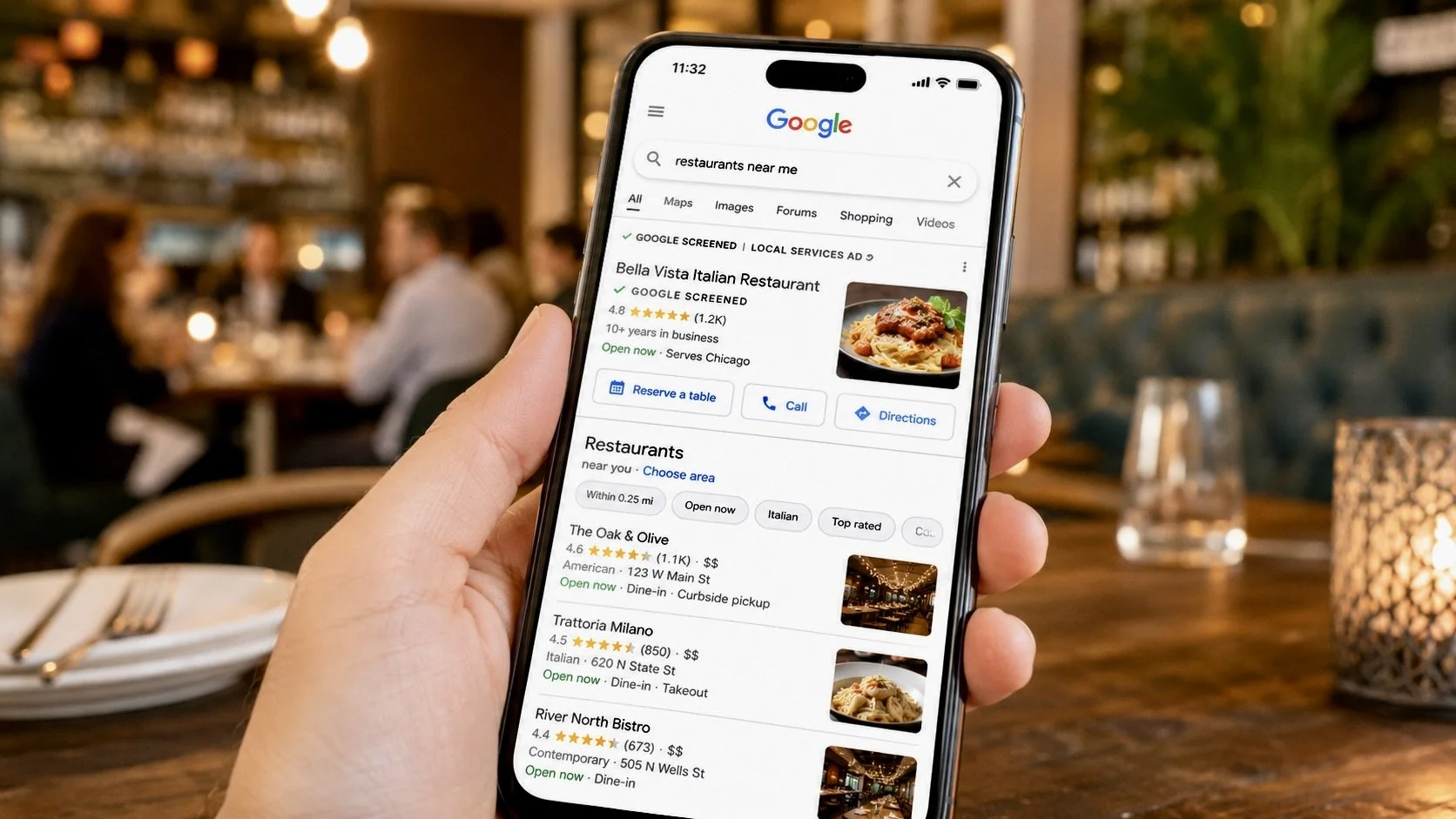
Local Services Ads, or LSAs, appear at the very top of Google Search results, above the regular ads and the map pack. For restaurants, the format is built around action. Google has confirmed that ads go live with a reserve a table, call, or directions button, so a hungry searcher is only a tap away from booking, calling, or driving to you.
The model is also different from traditional advertising. LSAs run on a pay-per-lead basis rather than pay-per-click, so you pay for phone calls and reservation bookings rather than clicks that may go nowhere. The directions button is currently free, which means you can pick up extra foot traffic without adding to your ad spend. Setup pulls directly from your existing Google Business Profile, so your restaurant name, hours, and details populate automatically. You choose a budget based on how many new customers you want each week and adjust it whenever you need to.
Restaurant LSAs vs. Standard Google Ads: What's the Difference?
Standard Google Ads for restaurants are keyword-driven and charge you per click. You bid on terms like "italian restaurant near me," write ad copy, and pay every time someone clicks through. LSAs flip that. There is no keyword bidding and no ad copy to write. Google matches your profile to relevant searches automatically, places you at the top, and charges only when a customer actually reaches out. For a restaurant owner who does not want to manage a complex PPC account, that simplicity is the appeal.
The Catch: No Google Guaranteed Badge for Restaurants
Here is the most important detail, and the one that changes your entire strategy. In other LSA categories, ads carry the green Google Guaranteed badge, a trust signal earned through background checks and verification. Google has stated that the Google Verified badge is currently unavailable for businesses in dining verticals, including the Food and Beverage, Restaurants, and Dessert and Coffee categories.
That absence matters. Without a badge to signal trust at a glance, the credibility has to come from somewhere else. It comes from your profile. A diner comparing options at the top of the page is going to look at your photos, your star rating, and the volume and freshness of your reviews. Those elements become the deciding factor in whether they tap your ad or scroll past it. This is the single biggest reason a strong Google Business Profile is no longer optional once you turn LSAs on.
Why Your Google Business Profile and Reviews Drive LSA Success
Because there is no badge to lean on, the profile itself becomes your primary conversion driver. Before you ever switch an ad on, the foundation has to be solid: high-quality photos, accurate categories that match what you offer, and most of all, a steady stream of recent reviews with consistent responses.
Reviews do double duty here. They build the trust that the missing badge would normally provide, and they signal relevance and activity to Google's local ranking systems. A restaurant with two hundred reviews and a recent, well-managed response history is going to convert far better than one with twenty stale reviews and no replies. Review velocity, the rate at which you earn new reviews, and response consistency are both things you can actively manage rather than leave to chance.
How to Automate Review Generation and Responses
The challenge for most restaurants is that asking for reviews and replying to every one of them is easy to neglect when the dinner rush hits. Automation solves that. A good system makes review requests effortless, captures customer information for follow-up, and ensures every review gets a timely, on-brand response.
This is exactly the kind of workflow North County Digital builds for clients. The setup includes branded QR codes that route happy diners to leave a review, a survey that captures contact information into the CRM, and AI-powered responses that reply to reviews automatically while staying on brand. The point is not the specific tools but the outcome: a profile that stays active, well-reviewed, and responsive without the owner having to remember to do it manually. That is what keeps a restaurant LSA-ready over time.
Where Restaurant LSAs Are Available Right Now
This is an early-stage rollout, not a nationwide launch. As of the initial release, restaurant LSAs are live in a limited group of cities including Atlanta, Boston, Miami, San Jose, and Indianapolis. Eligibility is being expanded over time, and Google lets any restaurant sign in to check whether the format is available in their area yet.
If your city is not on the list, that does not mean you wait and do nothing. The smartest move is to treat this as a prep window. The restaurants that have a verified, accurate, review-rich profile already in place will be first in line and ready to perform the moment LSAs reach their market. The work you do now pays off the day eligibility opens.
How to Get Your Restaurant Ready for Local Services Ads
Whether LSAs are live in your area or still on the way, the readiness checklist is the same:
Verify your Google Business Profile. A verified and properly connected profile is the one hard requirement. Onboarding for restaurant LSAs has no licensing, insurance, or background check steps, so a clean verified profile is genuinely all you need to start.
Clean up your NAP. Make sure your name, address, and phone number are accurate and consistent everywhere they appear online. Inconsistencies hurt both rankings and trust.
Build review velocity. Start earning reviews at a steady pace now and respond to every one. Do not wait for the ads to flip on.
Fix your categories and photos. Align your business categories with what you actually offer and load up high-quality, current photos. These are the elements diners judge in the absence of a badge.
The Bottom Line for Restaurant Owners
Restaurant LSAs are a genuinely new opportunity, and the no-badge structure means success depends less on the ad itself and more on the strength of your profile and reviews. The rollout is early and limited, which is precisely why preparation now is worth more than reaction later. Get your profile verified, your reviews flowing, and your responses consistent, and you will be ready to capture top-of-search visibility the moment it becomes available in your market.
Frequently Asked Questions About Restaurant Local Services Ads:
-
Yes. Google has launched a Local Services Ads vertical for food and beverage businesses, and nearly all major types of restaurants, coffee houses, and dessert shops are now eligible. Availability is rolling out by city, so you should sign in and check eligibility for your specific area.
-
No. The Google Verified badge is currently unavailable for dining verticals, including restaurants, coffee, and dessert businesses. This is why a strong, review-rich Google Business Profile matters so much for converting LSA traffic.
-
LSAs use a pay-per-lead model rather than pay-per-click. You pay for phone calls and reservation bookings, while the directions button is currently free. Your total cost depends on the budget you set and the lead volume in your market, and you can adjust your budget at any time.
-
The core difference is what you pay for. Regular Google Ads charge every time someone clicks, whether or not that click ever turns into a customer. Restaurant LSAs only charge when a diner actually calls or books a reservation, so you are paying for real leads instead of traffic. They also run off your Google Business Profile rather than keywords and ad copy, which makes them far simpler to launch.
-
The only requirement is a verified and affiliated Google Business Profile. There are no licensing requirements, insurance verification, or background checks for the dining vertical, which makes onboarding unusually fast.